
Three low-drama ways to let kids weigh in on routines without turning every rule into a courtroom argument.
Let them write the “routine menu,” not the rules
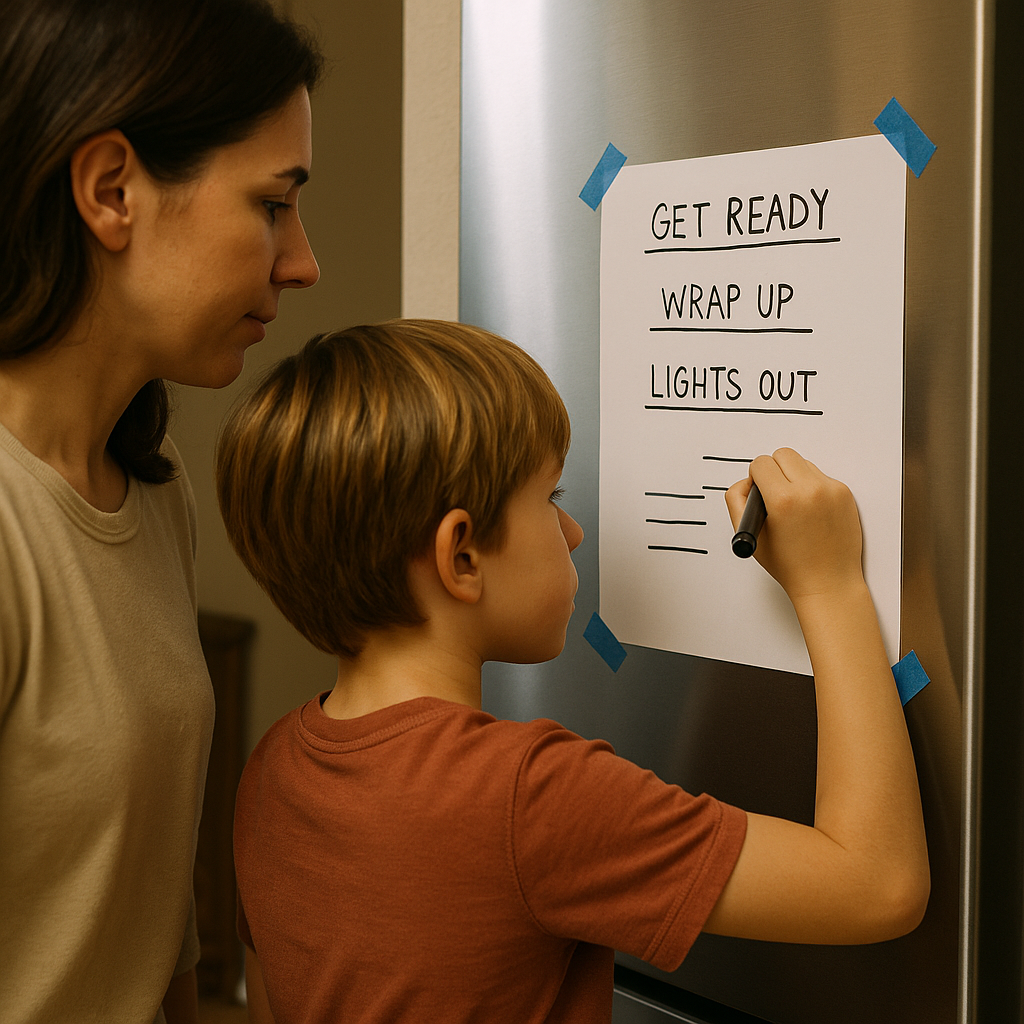
The quickest way I know to stop the nightly rules debate from eating the whole evening is to stop presenting the routine like it dropped from the sky. Instead, I hand my kid a marker and let them build a “menu” of acceptable options inside the parts that are non-negotiable. Not the rules. The choices.
Here is what that looks like in an ordinary house: you tape a piece of printer paper to the fridge with painter's tape (so it doesn't shred when you move it), write three fixed headings, and then step back. Mine are: “Get Ready,” “Wrap Up,” and “Lights Out.” Under each heading, I write the one anchor that isn't up for discussion. For example: under “Get Ready,” the anchor is “teeth get brushed.” Under “Wrap Up,” it's “a quick room reset.” Under “Lights Out,” it's “in bed at 8:30.” Then my kid fills in the menu items: which pajamas, which book, which stuffed animal, whether the room reset is books first or laundry first, whether toothbrushing happens before or after a last bathroom trip.
The funny part is the options they'll suggest are often stricter than what I would've picked. One week, mine insisted the room reset had to be “timer style” and begged for the loudest kitchen timer we own. I said yes, because it was their idea and I could live with it. When the opinions flare up later, I don't argue the whole routine. I just point at the menu and ask, “Which option are you picking?” If they want to add a new option, great. We add it at a calm time, not while someone's already in socks and mad about it.
This is still your routine. You're just letting them steer inside the lane lines, which is usually what they're asking for anyway.
Hold a two-minute “rule hearing” on Saturday morning

When kids start having bigger opinions about rules, they don't only want the rule changed. They want to be heard. If you don't give them a reliable place for that, they'll hold the hearing wherever they feel the most power. For a lot of families, that's the car, the bathtub, or the moment you say, “Shoes on.”
I started doing a tiny, predictable “rule hearing” once a week, and it cut down on random negotiations in a way I didn't expect. Two minutes. Not a family meeting. Not a values conversation. Literally a timer on the counter while the coffee is still hot and the cereal is still crunchy.
We sit at the kitchen table with a sticky note pad and one pen. My only job is to write down the kid's complaint without fixing it on the spot. Their job is to state it in one sentence. Examples that have come across my table: “I hate that I have to stop playing when the timer beeps,” “I want two snacks in my lunch,” and “I don't like shower night.” I write the sentence. Then I ask two questions, always the same: What feels unfair about it? and What would be a fair version you could live with? That second question is where you see their brains working. They often propose a trade they can understand: “Can I finish the level if I start when you say?” or “Can I pick the snack if it's from the snack bin?”
Then I decide one of three things, out loud: (1) yes, we'll try it for a week, (2) no, but here's what I can offer instead, or (3) not sure, let's collect more info. That last one is huge. It tells them you take them seriously without promising a win.
The reason this works is boring: it moves the argument to a time when nobody is already late and nobody is already tired. Also, it gives you a paper trail. When the same issue comes back on a Tuesday night, you can point to the sticky note and say, “Put it on the hearing list.” Kids love a system even when they're pretending they don't.
Use a one-week “trial rule” with a reset date

If your kid is lobbying hard for a rule change, the scariest part as the adult is the permanence. You can feel the slippery slope before it even happens. A “trial rule” fixes that without you having to deliver a big speech about authority.
Here's the structure I use, and yes, I literally write it down because I will forget what we agreed to: new rule, start date, reset date, and how we'll know it's working. The reset date is the secret sauce. Put it on your phone calendar immediately, and let your kid tap the “add” button if they're old enough. When the reminder pops up, it feels official in a way your voice doesn't.
A real example from my house: mornings were turning into a standoff about clothes. My kid wanted to pick the outfit in the morning, I wanted it picked the night before. We tried a one-week trial: pick in the morning, but the clothes had to be chosen from a pre-made drawer section (two shirts, two bottoms) that we set up on Sunday afternoon. Reset date: next Sunday. Success metric: we leave the house on time without me carrying shoes to the car. It wasn't perfect, but it gave us data. The first two days were chaos, then they got faster because they wanted to prove their idea could work.
When the trial flops, you don't have to gloat. You just point at the agreement and say, “Okay, we learned something. What's the adjustment for the next trial?” That shift matters. It treats their opinion as something worth testing, not something you either surrender to or crush. And when the trial works, you're not stuck resenting it, because you had a chance to evaluate it like an experiment instead of a power struggle.
One note: keep trials small. Don't run three changes at once. One new variable, one week, one reset. Kids can handle that, and so can you.