
Three places I log what the app suggested, what we chose instead, and what to tell each other before it turns into a fight.
The Weekend Plan Ledger (before anyone gets defensive)
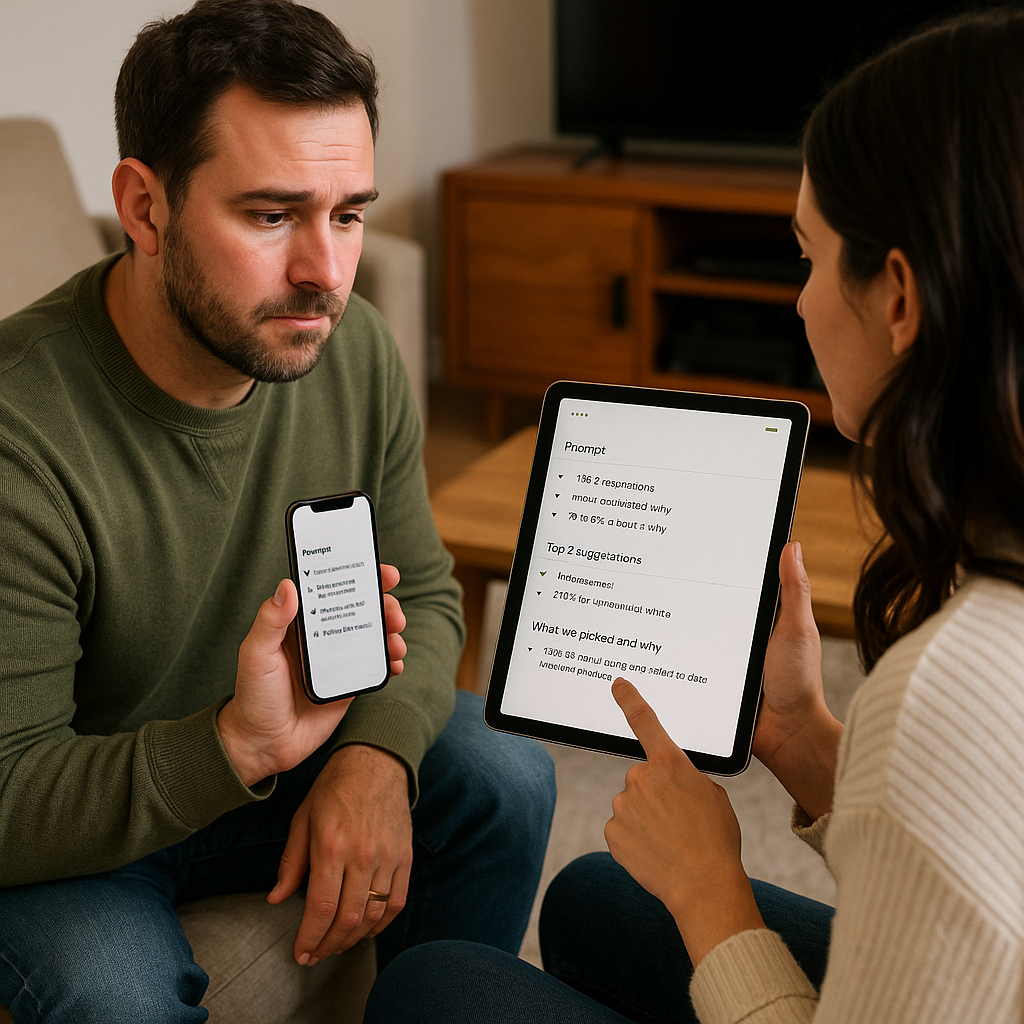
We started noticing a weird pattern: whenever one of us asked an AI assistant for date ideas or a Saturday plan, the answer sounded confident enough to become a trump card. Nobody meant for that to happen. It was simply harder to say, "I don't love that," when a tidy list popped up with bullet points and times. The fix in our house wasn't banning the tool. It was making the decision trail visible.
In a shared Notes doc, we keep a running "Weekend Plan Ledger" with three lines each time one of us uses an AI suggestion: Prompt (copy/paste it), Top 3 suggestions (short), and What we picked and why (one sentence each). The point isn't to keep score. It's to prevent an AI suggestion from quietly becoming the decision.
Two things surprised me once we did this for a couple of weekends. First, the prompts themselves were biased. If I typed something low-key, I meant no crowds, but my partner read it as no effort, and the assistant obliged with couch-and-streaming ideas. Second, the same assistant would repeatedly recommend the kind of outing one of us tolerates, but the other secretly hates (for us, anything with timed entry and a parking garage). Seeing that repetition in black and white made it easier to say, "Hey, this is becoming your default. Can we swap the criteria?"
We also added a tiny rule at the top: whoever brings AI suggestions also brings one non-AI option from their own brain. That one sentence has saved us from the vibe where the person who typed the prompt becomes the de facto decider.
Stop letting the car decide: the playback queue truce

The most pointless argument we kept having was in the car. Not the big stuff, just that simmering irritation when the playlist turns into one person's comfort soundtrack and the other person goes quiet. Personalized recommendations can make it feel like the platform is choosing for you, even though listening, searches, skips, saves, and other account-related signals shape the results.
Our truce is ridiculously simple and has worked surprisingly well: we agree on one queue rule before we back out of the driveway. Either (1) we alternate adding songs, or (2) one person drives and the other curates, but with a hard cap of 3 consecutive picks before the other person gets a turn. If we're using something like Spotify DJ, Apple Music autoplay, or YouTube Music radio, we still treat it as if a person were curating. Someone has to own the prompts and the skips, because otherwise it becomes passive-aggressive: skip, sigh, skip again, and then you feel petty for being mad at software.
Here's the relationship part that matters: we name what we want the music to do. Not a genre. A job. Keep me awake hits different than keep me calm. "Make it feel like a weekend" is code for upbeat and familiar. Giving the assistant a specific mood or purpose can steer the session away from whatever the app would otherwise recommend from the listening history.
Also, we stopped asking for a single perfect playlist. We build a short car set of 12 to 16 songs and reuse it for two weeks. That repetition sounds boring, but it removes the constant micro-negotiations that drain you before you even arrive. If one of us wants to experiment with the algorithm, we do it on the way home when nobody's trying to arrive on time.
The Allowance Check That Keeps App Convenience Fair

If you want to see technology quietly change a household, look at the tiny money decisions. Not the mortgage. The $5 here, the $10 there, the scheduled payment that runs until someone notices things have become lopsided. Once we started using scheduled payments and leaning on past transactions as a reference, we realized we were drifting into a new kind of unfair: not intentional, just inconsistent.
Our check is a monthly five-minute sit-down with two tabs open: whatever we use to send money (Venmo in our case) and a note titled Kid Money Rules. We review the last month and look for three things:
- Amount creep. If we keep copying what we paid last time without discussing it, that number can quietly become the new norm. We go back to our stated amount instead of treating an old transaction as the rule.
- Convenience bias. The kid who asks when you're already on your phone gets paid faster. So we added a rule: requests go in one place (a shared note or calendar reminder), and we pay them in a batch.
- Emoji storytelling. Venmo notes are tiny, but they land. A heart next to one kid's payment and a neutral note next to another kid's payment are the kind of things that get screenshotted in a sibling fight. We keep the notes boring on purpose.
We also stopped using AI to draft messages to the kids about money. It kept coming out overly formal, like a bank. Now we do a plain two-sentence text in our own voice: what the money is for, and what happens next time. When we don't outsource that tone, it's harder for one parent to sound like the nice one and the other to sound like the compliance officer.
This is the unglamorous part of relationships: the apps aren't trying to cause conflict, but convenience can turn last month's habit into this month's default. When we slow it down once a month, we stop fighting about fairness at the exact moment everyone is already emotional.