
Three small rituals for emotional spending needs, including a one-card rule for impulse buys and a small monthly margin you both protect.
The $20 pause card on the fridge
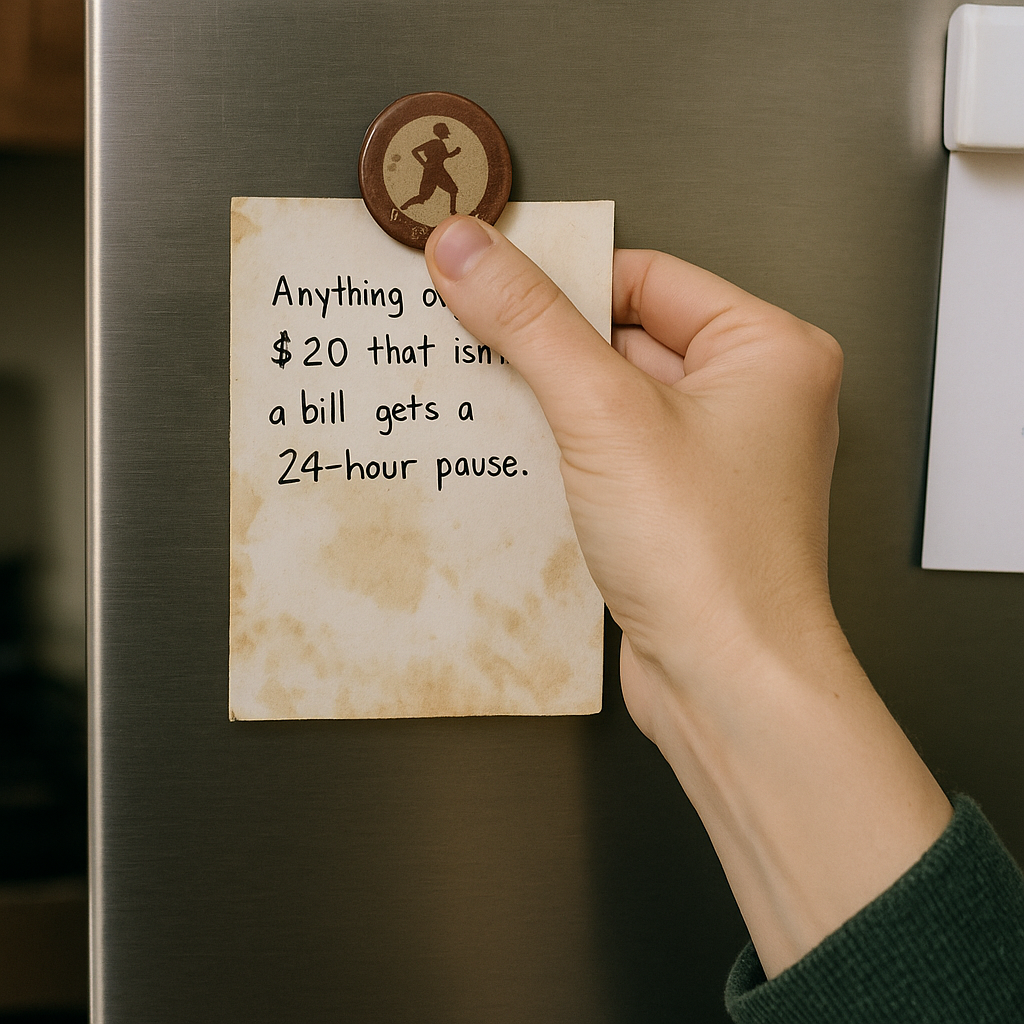
I have a stained 3x5 index card on our fridge held up by a sad little magnet from a 5K we never talk about. It says: Anything over $20 that isn't a bill gets a 24-hour pause. Not because we can't afford $21. Because we can't afford the tone that shows up when one of us clicks Buy Now to fix a feeling the other person doesn't know is happening.
Here's how it works in real life. You want the nice olive oil, the new running shorts, the audiobook, the midweek takeout that feels like a hug. You write it on the card under today's date. Just the thing and the price. No justification essay. If you still want it tomorrow, you buy it. If it's a joint expense (groceries, kid stuff, house stuff), you add one more line: Why now? That question is the entire point. Is it convenient because you're cooked? Is it comfort because the week has been ugly? Is it control because everything feels wobbly?
Two things surprised me once we started doing this. First, plenty of things fall off the card on their own once the initial urge passes. Second, when we do buy it, we argue less because the other person isn't blindsided. They saw it sitting there next to the mustard. The emotional need becomes visible without turning into a courtroom. And when either of us is about to break the rule, we can say it out loud: "I'm about to buy this because I'm stressed." That sentence is so much cheaper than a fight.
Name the feeling first, then pick the category
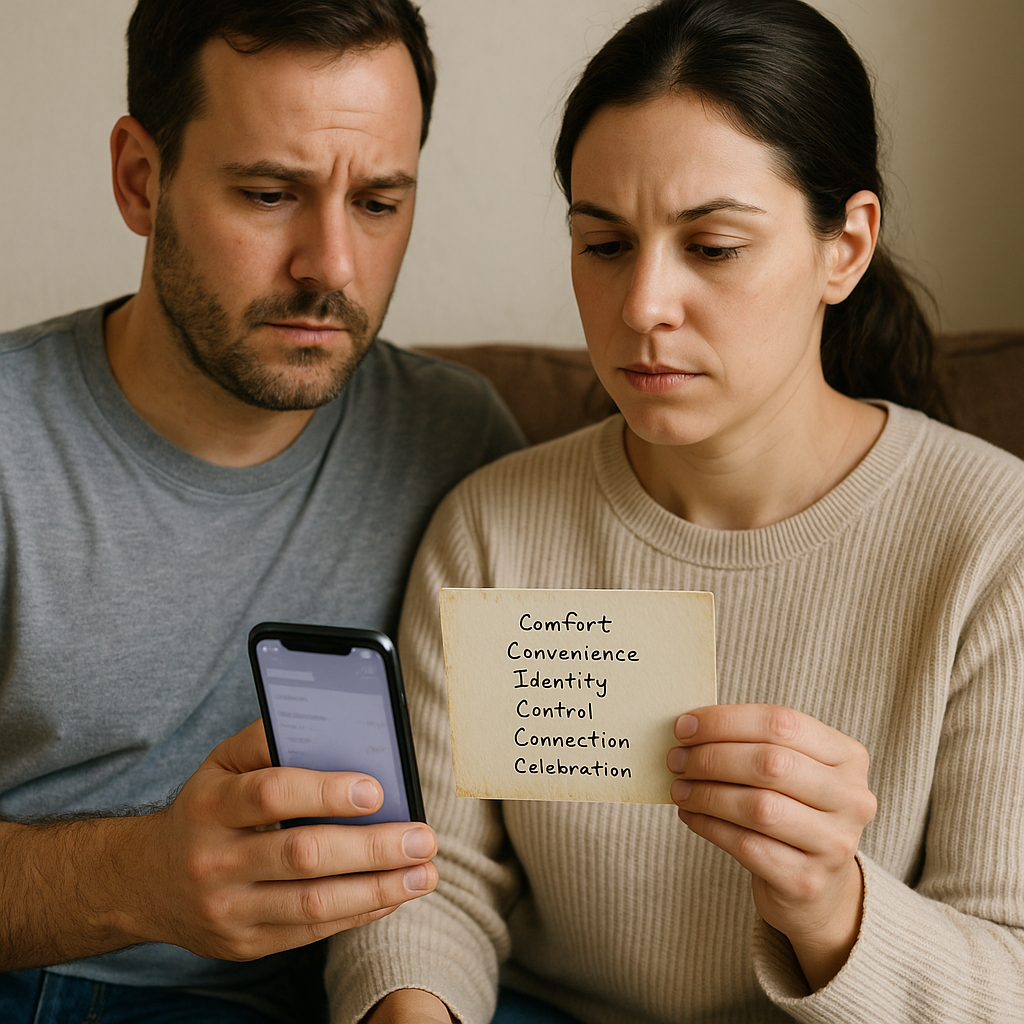
When money gets tight after a new baby, a move, or a job wobble, couples can respond very differently. One partner may become much more watchful about spending, while the other may start treating small purchases as a way to get some breathing room. Neither role feels good to live inside. What helped us was separating the feeling from the purchase before we touched the bank app.
We keep a note in our shared iPhone Notes (pinned, because otherwise it disappears under grocery lists) called What this is trying to solve. The list is short on purpose. Ours is: Comfort, Convenience, Identity, Control, Connection, and Celebration. When one of us wants to spend on something unnecessary, we pick a category first. Just one. It's weirdly grounding to say, "This is Convenience" instead of launching into a defense like you're on trial.
Then we match it to a spending option that won't create a second problem. Example: If it's Comfort, the answer isn't always a $78 skincare order at 11:47 p.m. It's a shower, a clean hoodie, and permission to buy one fancy candle next time we're already out. If it's Identity (the one that gets people), it's not upgrading your whole work wardrobe. It could be one good haircut every eight weeks, or replacing the one item you hate wearing. If it's Connection, it's rarely the random Amazon cart. It's something you do together, even if it's a $12 dessert split on a Tuesday.
This doesn't stop spending. It makes it legible. And it keeps the conversation in "we" language. You're not arguing about a blender. You're figuring out why one of you is reaching for a quick fix, and whether there's a smaller, kinder way to get that need met without leaving the other person feeling like the bad guy.
Protect a tiny monthly margin you never interrogate

The fastest way I've seen couples get mean about money is when every single purchase has to be justified. Not big purchases. All of them. The $6 coffee, the $14 lunch, the replacement phone charger, the dumb little treat that makes a rough day tolerable. When there is zero slack, you start cross-examining each other like you caught your spouse stealing from the register. It doesn't matter how careful you are, resentment shows up anyway.
Our fix was boring, which is why it worked: we created a tiny monthly margin explicitly for emotional spending, and we agreed to stop interrogating it. Ours is $50 per person per month. Yours might be $25. It might be $10 while you're in a brutal season. The number isn't the magic part. The rules are.
- It resets monthly. No rolling over and hoarding like it's a high score.
- It's private by default. You can share what you bought, but you don't have to.
- It's not for joint stuff. No sneaking diapers or gas in there because you're embarrassed about being short.
We track it in the simplest way possible: two lines on the same fridge card as the pause rule, because if it lives in an app, I will forget it exists until I'm already annoyed. When one of us spends from that $50, we jot it down. Lunch out - $14. New book - $11. That tiny act keeps it from turning into secret spending and keeps the other person from doing paranoid math in their head.
What I didn't expect was how much kinder we got when there was a sanctioned place for small comforts. The money pressure didn't disappear. But the relationship stopped taking the hit every time one of us needed a little relief.