
A three-step script, a pause before new consequences, and one debrief can help handle discipline disagreements without putting your kid in the middle.
The Sticky-Note Ladder
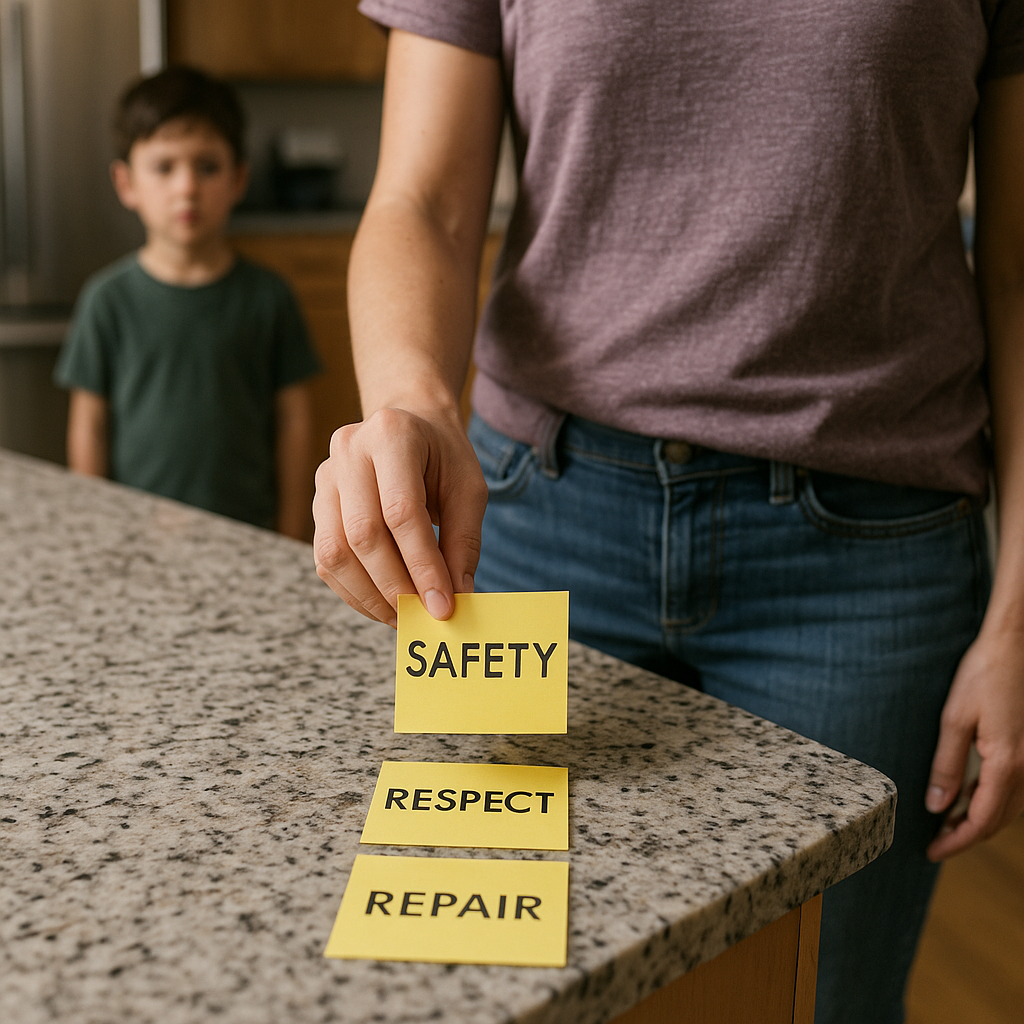
I keep a tiny pad of sticky notes in the same drawer as the batteries and band-aids, because that's where our household emergencies live. When rules and discipline are the emergency, the fastest way I've found to stop the damage isn't to win the argument. It's to keep the kid from getting stuck in the crossfire long enough for two adults to act like two adults.
Here's the move: write three notes and put them on the counter where you can't miss them. The notes say: Safety, Respect, Repair. That's the ladder. If you and your partner disagree in the moment (screen time, tone, lying, backtalk, whatever), you pick the highest rung you both agree applies right now.
- Safety is for stuff like hitting, running into the street, or anything that requires an immediate stop. The action can be firm and fast.
- Respect is for the words and tone (from the kid and from you). It's where a parent can say, "Pause. Try again," without turning it into a courtroom.
- Repair is what you promise out loud when you can't agree: you'll circle back, and the kid won't be punished twice because two grownups couldn't align.
Consistency matters because children benefit from clear, predictable rules and calm follow-through. When parents regularly undermine each other's rules, children can receive mixed messages about expectations and consequences. The ladder keeps the moment contained. It gives your kid one clear signal: the adults might disagree, but the basic rule is still clear.
Pause Before New Consequences

There's a specific kind of couple-fight that shows up when discipline is on the table: one of you wants to add a brand-new consequence on the spot (no soccer, delete the app, cancel the sleepover), and the other is suddenly arguing about fairness, consistency, and whether that's even connected to what happened.
My fix is boring on purpose: when we disagree, we wait until we're calm before deciding on a new consequence. You can still stop the behavior in the moment. You can still do immediate, reasonable stuff (phone goes on the charger for the night, the playdate ends early if someone can't keep hands to themselves). But you don't invent a brand-new rule, price it in anger, and then try to defend it while your kid watches you two bargain like you're at an auction.
Here's how it sounds out loud, because wording is half the battle: "We're handling tonight. We're not deciding long consequences until we've both slept. You'll know by Tuesday after dinner." Put it on the calendar if you need to. If you're a shared-notes couple, this is a perfect spot for a one-line entry so you don't re-litigate it at midnight.
The child-development point is simple: kids benefit from clear, predictable rules and calm follow-through. When consequences are invented in the middle of an argument, children can get mixed messages about what the rule actually is and what will happen when they break it. This pause puts a fence around adult impulsivity. It models something kids don't get enough of: adults can set limits without making decisions in the heat of an argument.
Also, it keeps you from the slow poison of resentment. Nothing corrodes trust between partners like undoing each other in front of a kid, then pretending bedtime went fine.
Debrief Like a Referee

If you've ever had the same discipline disagreement three times in one week, it's usually because you're trying to solve it like a legal case. Who's right, what's fair, who said what first. Meanwhile, your kid is learning a sneakier skill: how to get two adults to argue about process while the original behavior slides out the back door.
I've had better luck treating the debrief like a referee's report. Short. Factual. Focused on what happens next time. Here are the only questions that make the cut at our kitchen table:
- What did the kid do, in one sentence? No editorial. If you can't say it cleanly, you're still heated.
- What did each of us do next? This is the part that stings, because it surfaces the inconsistency without turning into blame.
- What are we teaching if we repeat that exact pattern?
- What's the script for next time? Literally write one or two sentences you can both live with.
Then, and only then, you loop your child back in with a unified version. A simple update: "We talked. Here's the rule. Here's what happens if it breaks. Here's how you can fix it."
This protects development in a way parents don't always notice: it keeps attachment and authority from getting tangled together. When parents consistently take opposite roles, children can end up receiving conflicting messages about rules and consequences. A clean debrief cuts that off. Your child gets to practice the skill you're asking for (stopping, restarting, repairing) without also carrying the job of tracking which parent is currently winning the household argument. And if you catch yourself wanting to add a closing speech, don't. End it. The ending is the point.