
Sleep training can turn nighttime parenting into a series of tiny decisions: who gets up, when to feed, whether to change the plan, and what the other parent already did. A simple whiteboard log, shared sound-machine settings, and a five-minute morning debrief can take some of that decision-making out of the middle of the night.
The hallway whiteboard
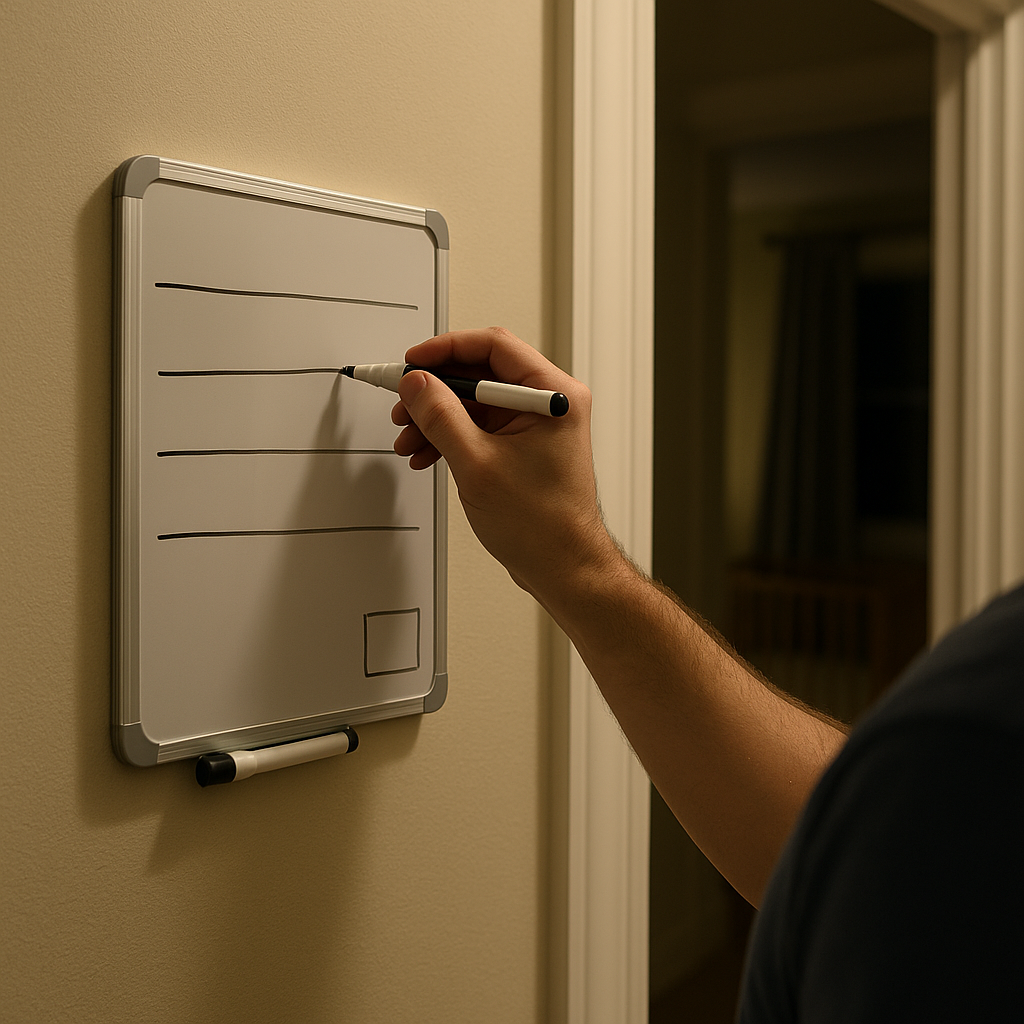
We tried to be the kind of couple who could do a calm, detailed handoff in the dark, but it didn't quite work out. What worked was a $10 dry-erase board (the basic kind with a marker clip) screwed into the hallway wall outside the nursery. The point is that the person coming off shift can write without waking anyone, and the person going on shift can read it without asking, "Wait, did you feed already?"
The board has three entries, and we keep them brutally simple: Last feed (time + oz or which side), Last diaper (wet/dirty), and Sleep plan tonight (the one sentence we agreed on earlier). If we're in a stretch where we're doing timed check-ins, the plan line might be: "5/10/15, no pickups unless spit-up." If we're doing pick-up/put-down, it might be: "Pick up to calm, put down drowsy, repeat." The important part is agreeing on the approach beforehand rather than making a new plan during a nighttime wake.
Two small details made it stick. First, the marker is low-odor because the regular ones smell like a high school math class and linger in the hallway. Second, we added a small box labeled Meds to record whether medicine was given and when. Any dosing follows the child's label or pediatrician's instructions.
This is also the sneaky mental-load win: whoever handled the last wake is not responsible for narrating, defending, or remembering it. They just write three fragments and go back to bed. In the morning, we erase it together while the coffee brews. It takes 20 seconds, and it keeps small misunderstandings from turning into bigger arguments.
Program the sound machine once
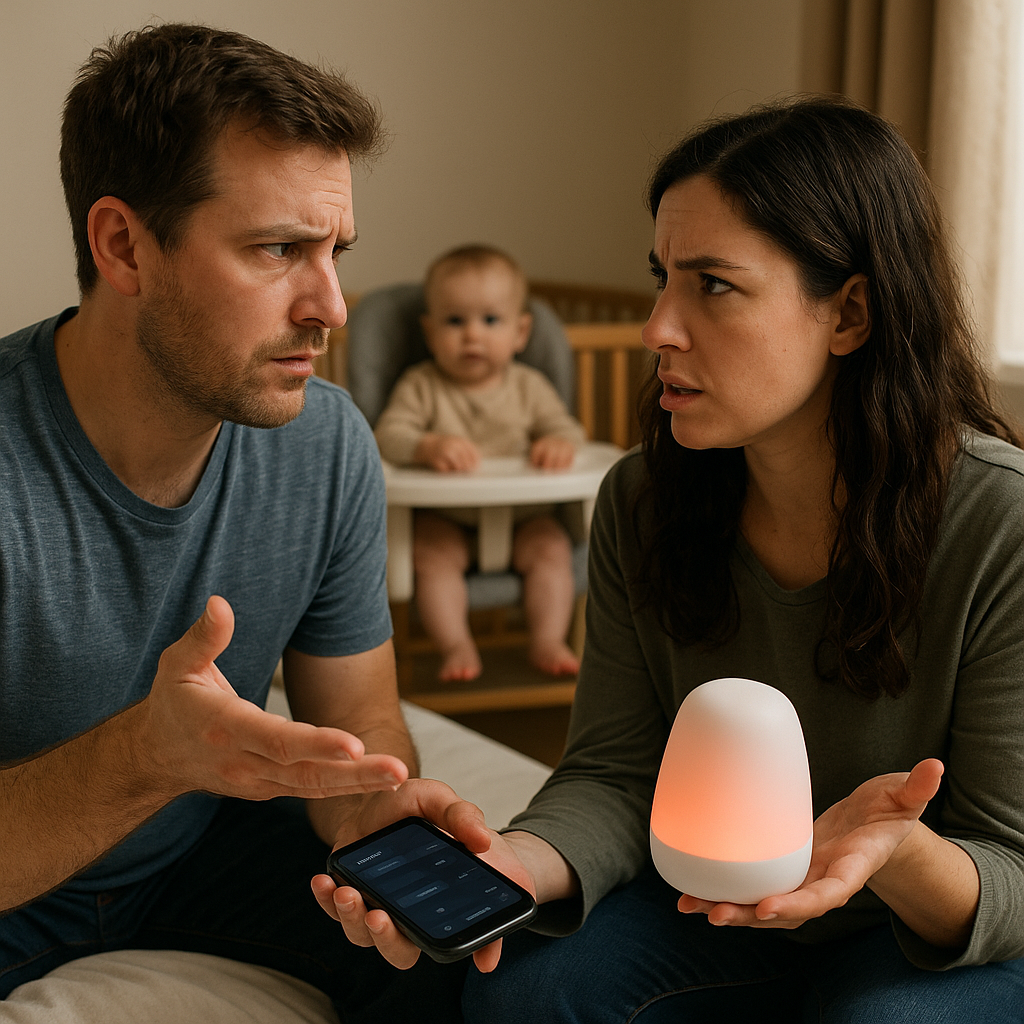
If you own a Hatch or any app-controlled sound machine, you can accidentally turn it into a relationship stress test. One person keeps tweaking volume and color at every wake. The other person swears the baby only sleeps with the exact same settings as last week.
What fixed it for us was treating the sound machine like a shared household setting. We sat down at lunchtime, with the baby awake, and made two presets and only two. One is Bedtime: steady white noise, a dim red glow, and a low volume that provides consistent background noise. The other is Night Feed: same sound, light slightly brighter, so you're not doing the bottle like a cave explorer, then it snaps back to Bedtime when we're done.
Then we made a rule that sounds petty until you live it: no changing the settings after lights out. We agreed on the settings ahead of time, so neither of us has to make unnecessary decisions during a nighttime wake. The only exception is travel, because hotel rooms are their own weird ecosystem, and they can make it harder to keep the same routine.
This is where the mental load shows up in a sneaky way. If one person is the only one who knows the app, the only one who can remember the settings, and the only one who can troubleshoot when Bluetooth drops, they're the default parent by midnight. So we do a literal two-minute swap: each of us has the app, each of us can start the routine, and each of us knows where the physical buttons are on the device when the phone is dead.
Also: label the presets with names that match what you do. Ours is called Bedtime because that's the job. The goal is to make the routine easy for either parent to follow.
The 7 a.m. five-minute debrief

Sleep training involves decisions about when to respond, how to respond, and when to adjust the plan. If you don't pick a time to make those calls together, they get made in the worst possible moment, when somebody is rocking in the nursery chair with a phone flashlight in their teeth. We started doing a five-minute debrief at 7 a.m. (or whenever morning happens), and we keep it to five minutes, usually at the kitchen counter while the kettle heats.
We use three prompts, and we don't add a fourth, no matter how tempted we are:
- What happened? Just the facts. Two wakes. One feed.
- What are we doing tonight? Name the method and the limit. For example: "We do check-ins at 5 and 10, and if there's a third wake, we do a feed." Or: "We keep bedtime the same, but we move the last bottle 15 minutes earlier."
- What needs prep? This is where the mental load gets assigned. Refill the formula container. Wash the spare sleep sack. Charge the white noise machine. Put two clean crib sheets within arm's reach because a 3 a.m. spit-up is much easier to handle when a clean sheet is already nearby.
The reason I like this setup is that it respects how our brains work after a rough night. Starting with logistics helps us stay focused on what happened and what we need to do next. And it keeps the invisible work visible: whoever says, "We need to size up diapers today," is doing useful noticing.
The debrief also made us more consistent. When you know you'll talk about it in daylight, you're less likely to toss the plan in the trash at 2 a.m. just to stop the crying faster.