You Will Cry Seeing How Much This Man Cares for His Aging Dog
Piper is over 18 years old, and his body carries the weight of that time. The Miniature Pinscher is blind, deaf, toothless, and living with canine cognitive dysfunction, commonly known as dog dementia. Some nights, confusion keeps him restless for up to three hours. Yet he still navigates his Jacksonville, Florida, home with confidence, guided by memory and scent.
When Dennis Gerard walks through the front door after work, Piper smells him from the back of the house and slowly makes his way forward to greet him. Even without sight or sound, he knows exactly who has come home.
From Abandoned to Adored
Piper’s life began with uncertainty. He and his brother were abandoned in a box outside a shelter in Jacksonville. Piper was malnourished when Dennis met him, small and hesitant in a loud, unfamiliar environment. Dennis adopted him at about one year old, and that decision shaped the next 17 years of both their lives.
At first, Piper needed patience and reassurance. Over time, he became deeply attached to Dennis and the routines of their home. Their bond now anchors him as his senses continue to fade.
Adapting to Blindness and Dementia
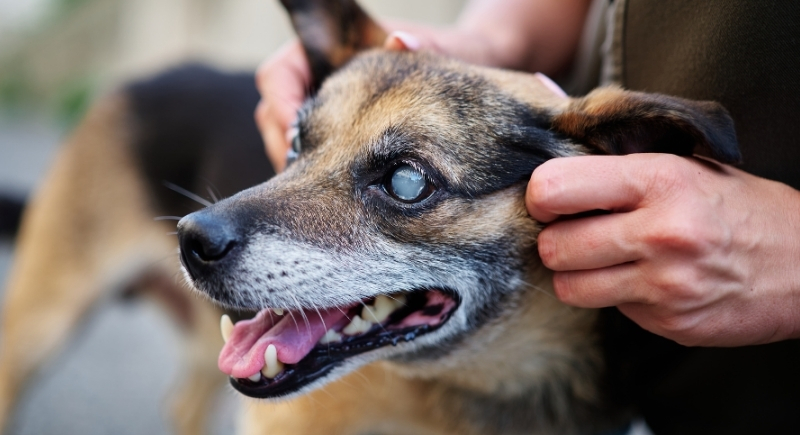
Image via Getty Images/boytsov
When Piper’s eyesight began to decline, it happened gradually over about a year. Dennis used that time to help him memorize pathways around the house. By the time Piper lost his vision completely, he already understood where walls, furniture, and doorways were located.
His hearing faded more recently. Now Dennis communicates through touch, guiding Piper gently instead of calling his name. Dementia adds another layer of care. Moments of confusion are no longer brief, isolated incidents; they have become a sustained, daily reality.
Dennis keeps the environment predictable, limits sudden changes, and stays close during difficult episodes. Piper still maintains an internal clock. He knows when it is time to eat and when it is time to rest. The consistency helps steady him.
The 14-Year Lap Tradition
For 14 years, whenever Dennis sits at a table, Piper climbs into his lap. The tradition actually began in 1992 with Dennis’s first Miniature Pinscher, Rocky. After Rocky passed away, Dennis rescued Piper, and the ritual continued naturally.
Today, if Dennis pulls out a chair, Piper carefully hoists himself up. If he slips down, he tries again. Dennis sometimes places a pillow on his lap to make it easier for him.
During family card games, Piper rests there, occasionally angling his head toward the table as if studying the cards. In a life where so much has changed, that ritual remains.
Care That Adjusts With Age
Caring for Piper now requires constant adaptation. After losing all his teeth about a year ago, he began eating from specially angled dishes that make swallowing easier. After meals, he often settles into Dennis’s lap for a nap.
Once a week, Dennis places Piper in warm water and supports his body so he can gently move his hind legs. This bath time has become therapeutic. The buoyancy reduces strain, and the physical contact provides reassurance. His grooming has become part of maintaining mobility and comfort.
Even in advanced age, Piper’s personality shines through. He sometimes fakes a limp to earn extra treats. Dennis admits he always gives in.
Dennis often says he understands that he is Piper’s entire world. The sense of responsibility shapes everything from daily routines to late-night caregiving. He adjusts his own life to match Piper’s pace.