A 4-Year-Old Found a Tudor Gold Pendant While Playing with a Metal Detector
In May 2009, James Hyatt, the four-year-old from Billericay, Essex, joined his father, Jason, and his grandfather on what appeared to be a routine afternoon with a metal detector. James had never used one before, and he barely stood tall enough to carry it comfortably. Then the machine started beeping.
At first, the adults assumed they had found another scrap of metal buried under the soil. Instead, a quick dig to roughly eight inches underground revealed a flash of gold that had survived underground for centuries. James had stumbled onto a Tudor-era religious pendant tied to one of the most dramatic periods in English history. For a kid who joked that “only pirates use treasure maps,” it turned out to be one of the luckiest first attempts ever recorded with a metal detector.
A Tiny Discovery With Massive Historical Value
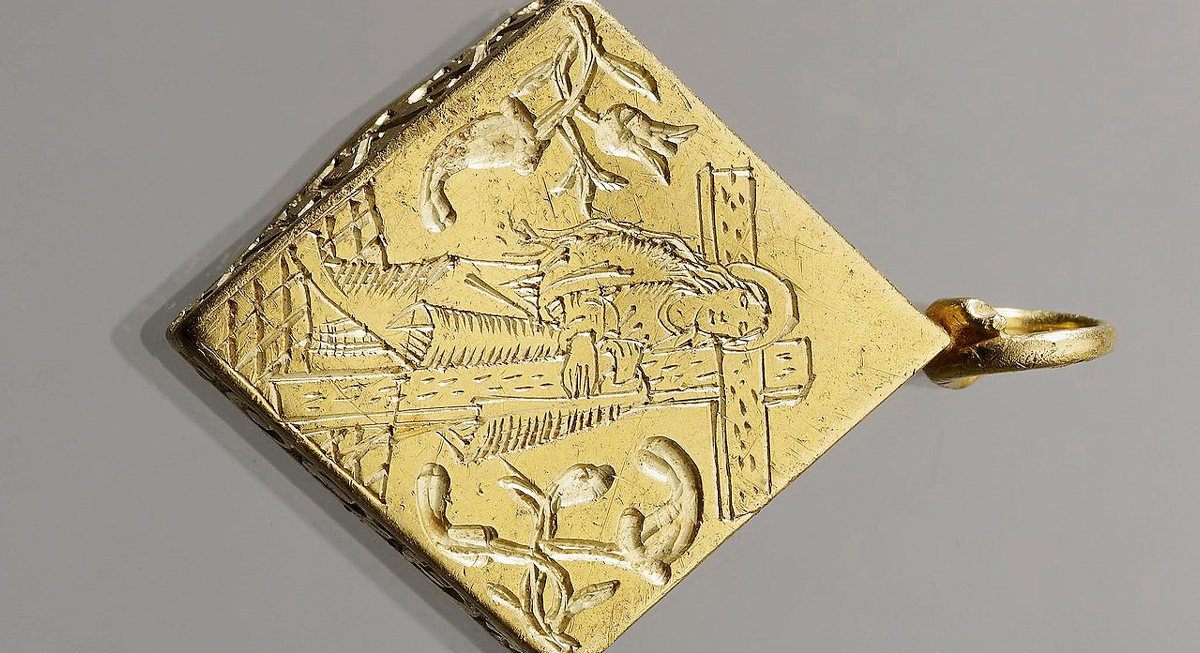
Image via Wikimedia Commons/MauraWen
The artifact found in Hockley, Essex, turned out to be a reliquary pendant dating back to the early 1500s during the reign of Henry VIII. Experts believe wealthy Christians once wore pieces like this both as jewelry and for spiritual protection. The pendant itself was about the size of a credit card and contained high levels of pure gold. Its details made historians especially excited.
The front featured an engraved image of a female saint, believed to be either the Virgin Mary or Saint Helena, holding the True Cross. The reverse side showed a heart surrounded by markings representing the Five Holy Wounds of Christ. Along the edges were inscriptions linked to the Three Magi: Caspar, Melchior, and Balthazar. During the Tudor period, many people believed those names had healing powers.
The pendant also served as a reliquary, meaning it once housed sacred relics in a hidden compartment. Historians suspected it may have held fragments tied to Christ’s crucifixion or crown of thorns. That possibility added even more intrigue once the pendant reached experts at the British Museum.
The Mystery Inside the Pendant

Image via Pexels/Kristy Mayo
One of the biggest questions surrounding the find involved the sealed compartment hidden inside the gold locket. Museum conservationists spent nearly two hours carefully opening it after the pendant arrived for study. After sitting underground for roughly 500 years, people hoped the tiny cavity might still contain a religious relic connected to medieval Christianity.
Instead, researchers found soil residue and root fibers that had slipped underground over the centuries. Even without a sacred artifact inside, the pendant remained an extraordinary archaeological discovery. Historians described it as a rare example of how religion and luxury often overlapped during the Tudor era.
The object eventually became known as the “Hockley Pendant” and was added to the British Museum’s medieval collection in 2012.
The Wild Price Estimates
Early reports sent the story into overdrive after a coroner initially estimated the pendant could be worth as much as £2.5 million, or roughly $4 million at the time. That figure exploded across newspapers and television reports.
However, the final valuation was much lower. The UK’s Treasure Valuation Committee later assessed the pendant at around £70,000, which still translated to about $110,000 in 2009. Under Britain’s Treasure Act, the payout was split between the Hyatt family and the owner of the field where the pendant was found.
Jason Hyatt seemed more amused than shocked by the entire situation. He later joked that James had always been unusually lucky, describing him as the type of kid who could stick his hand into a couch and pull out cash.